True! Here’s a little additional information since the north is in virus season.
A virus is a protein wrapped in a protective fatty lipid. Heat will melt the fat, then break down the protein. That’s why viruses last longer on surfaces and clothing in the cold season, increasing probability of transmission. A virus can remain intact on a shopping cart handle for up to 24 hours in the winter, for example.
You can also rapidly break down the fatty lipid using isopropyl alcohol, or break down the protein directly using hydrogen peroxide. Be careful using the latter. It can bleach or discolor dyed textiles.
Another example; mammals probably developed pregnancy using an Autoimmune virus’ genes in the placenta to prevent the fetus from being destroyed by the immune system.
That’s why I always carry a small bottle of isopropyl alcohol as my hand sanitizer. It’s also great that my local grocery store has sanitary wipes right beside the carts so you can wipe down the handle before using it.


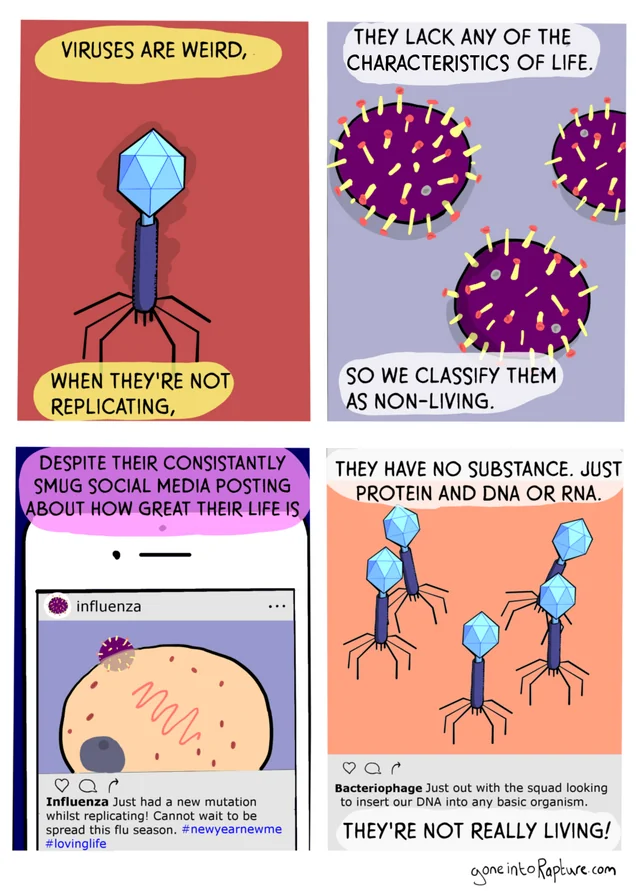
True! Here’s a little additional information since the north is in virus season.
A virus is a protein wrapped in a protective fatty lipid. Heat will melt the fat, then break down the protein. That’s why viruses last longer on surfaces and clothing in the cold season, increasing probability of transmission. A virus can remain intact on a shopping cart handle for up to 24 hours in the winter, for example.
You can also rapidly break down the fatty lipid using isopropyl alcohol, or break down the protein directly using hydrogen peroxide. Be careful using the latter. It can bleach or discolor dyed textiles.
Bats use heat to fly off their viruses, they get pretty bad ones, but when they’re flying Bats get really hot. So it burns them off.
Also, some viruses have evolved into us and ended up serving functions in the human bawdy.
Yup. Up to 8% of the human genome is comprised of ancient viruses.
https://www.ncbi.nlm.nih.gov/search/research-news/17366
As an example we have reverse transcriptase that is derived from viruses.
There was a Kurzegadt video about the virome recently
However, I can’t find it now and nor can I spell their name, so apologies on both counts
I believe you’re referring to https://youtube.com/@kurzgesagt
I think they’re on https://nebula.tv too, if you prefer that to YouTube.
I can’t see them on nebula, I just looked on the nebula app, but also on their Reddit and website
Another example; mammals probably developed pregnancy using an Autoimmune virus’ genes in the placenta to prevent the fetus from being destroyed by the immune system.
That’s why I always carry a small bottle of isopropyl alcohol as my hand sanitizer. It’s also great that my local grocery store has sanitary wipes right beside the carts so you can wipe down the handle before using it.
the swedish department of health says the opposite though, that you have to wash your hands with soap to affect at least some viruses.
The WHO says the same. Soap is a surfactant, so the viruses will be mechanically removed from the skin, and flushed away by the water.
My comment was meant to be in regards to sanitizing surfaces. I’m sorry if that was unclear.